Monday, February 22, 2010

Fleecewood!

So after three days of all these exciting stops and lots and lots of windy mountain road through the bush, I was more than ready to settle down in one place for a while. I had met Anne, the proprietor of Fleecewood Farm, back in October at a Rural Women's Institute Natural Fiber Expo, where both she and Betty were vendors. I have to admit, my interest definitely rose from seeing her beautiful colored fleeces, most in a breed she's developed herself, called Fleecewood Leicester. It's a cross between an English Leicester and an NZ Halfbred, which is, in turn, a longwool/merino cross (like a Corriedale). This, in turn, leads to a crimpy, soft, and still lustrous fleece in some of the most gorgeous shades of brown and grey. The fleece I ended up with (because, c'mon, let's be serious here, of course I bought a fleece) is this light mocha-grey-brown color that first caught my eye at the Expo and that I've never really seen before. So I was more than happy to go explore the farm and flock!

One of the coolest things about Anne is that she's basically run this farm single-handedly for twenty years, doing all the maintenance and construction herself. Therefore, she didn't blink an eye at assigning me the really physical jobs that other WWOOF farms tend to save for male WWOOFers. So the first couple weeks of my stay, I worked in the paddocks, rebuilding the cold weather sheep shelters, whose original purpose were to contain car parts as they were shipped to New Zealand.

These shelters had first gone up twenty years previous, and hadn't had anything done since then. It was interesting, to say the least! Often, I got to play MacGyver while attempting to cobble together a structure that didn't put weight on the rusted-out bits, or avoided the predominant wind (which changed direction with every paddock), or didn't crowd the manuka tea trees. It was very hot, dirty, sweaty, and frustrating work at times, but you also couldn't beat the sense of accomplishment when all twenty shelters were finally back up and I knew I had done all of it with my own hands. And sure, they weren't the most level or plumb of structures, but I was really proud when I put my tools away for the final time.

Since I was in the paddocks the entire time I was working on these, the sheep on the farm also got used to me, and, in my last couple days there, I often went up to the paddocks in my spare time and just sat down in the grass and chilled out with them. Part of me knows that these sheep were conditioned to associate Human with Bringer of Food, but most of me knows it was also one of the coolest feelings ever to stand in the center of a paddock, the breeze taking away the bite of the sun's heat and drying the sweat on my skin, as about eighty ewes start moseying my way.

I also really love it when sheep are comfortable enough with you that they can turn their back on you:


I also went to visit the lambs to take pictures of my latest pair of knit socks, and had these two lovely helpers:

Don't they just look like they're going to get into some serious trouble?

Anyway, socks:

Noro Silk Garden Sock, two different colorways, four row stripes, my regular sock pattern. Can I just say how much I love Noro, even though the yarn itself is rather crap? These were knit in about a week, since I just wanted to keep seeing how the color would change next!


The final project I worked on at Fleecewood was washing fleeces for processing into batts, and then playing with lichen and onion skins in my first attempt at natural dyeing. What a hard life I lead, eh?


It was a grey, rainy day while I was dyeing these, and it was absolutely wonderful to sit comfortably in the garage, tucking my toes close to the gas rings to keep warm and occasionally stirring these incredibly aromatic pots of wool. After about an hour of simmering, we had:

The peachy-brown was dyed with lichen, with alum and cream of tartar mordant. The acid yellow was onion skins, mordanted with alum, cream of tartar, and ferrous sulfate. Anne and I split these, and I blended my lot together to get this heathery, old gold color that is screaming to be cabled mittens.

I just need to keep spinning it!

So from the sheep shelters, to the sheep themselves, to the fleeces and dyeing, I had a wonderful time at Fleecewood. Seeing Anne, a strong, single woman, doing this on her own, has made my little, farfetched dream of someday owning my own farm seem not that farfetched anymore. I feel like the possibilities are limitless, and I can't wait to keep exploring!

To say goodbye, I give you a quizzical Tweety the sheep and a sullen and rained-on Boy the goat, both of whom I got to know pretty well at Fleecewood. Both had leg injuries in the first week I was there, and so were confined to the race down by the shed so that Anne could keep an eye on them and treat them as needed. I would break branches off the tree lucerne for them whenever I would walk by, and Boy would often come nibble on my ear when I was trying to saw wood for the sheep shelter cross-braces. They always made my day!

Making my winding way back North

Hello all! Greetings from Nelson, where I am comfortably ensconced back at Betty's, the llama lady I stayed with way back in October and November. We've just wound down from an all-felting, all-the-time weekend up in a little place called Teapot Valley, and I finally found the chance to talk about my trip from the bottom of the South Island to the top, and then my time at my latest farm, a wonderful place called Fleecewood. So here we go!

I decided this time that, since I'd already traveled the East Coast of the South Island, it would be good to head up the West Coast to get back to Nelson. This is the least populated and most forested area of New Zealand, and so the twenty-two plus hours I spent on buses (spread over three days, thank goodness) was mostly shrouded in lush, tall greenery, with occasional glimpses like this:

and stops to see things like this:


Which, for the life of me, I can't remember the name of. I don't know if you've noticed so far, but I'm a pretty bad tourist. I tend to wander off the beaten path, both literally and figuratively, and instead of dutifully reading the info sign about the waterfall or trying to capture its enormity on camera with everyone else, I end up crouched in the bushes on a deer path, getting bitten ferociously by mosquitoes and taking pictures of random bits of river that had an interesting play on color and shadow and light.


So I'll be absolutely no help when you try and plan your own trip to New Zealand ("You need to go see that thing! In the place! With the other thing!"), but darnit if I don't have good adventures along the way.

One of the other places we stopped was the Pancake Rocks, about a kilometer of unusual rock formations on the coast.


One of the other cool things about this area was that the entire pathway around the Pancake Rocks is surrounded by harakeke, or New Zealand native flax.

I've so far been too intimidated by the native bush conservation efforts to filch a leaf off of this to process for spinning, but I might work up the courage soon. Harakeke is used a lot in Maori weaving, but it's used in strips about an inch wide, whereas I want to see if it will strip down and ret into linen. Stay tuned!

Okay, this is getting rather long, so I'd better split this into two blog posts. Stick around for what happened when I finally got off the bus and made it to Fleecewood, the next stop on my WWOOFing tour!

Monday, February 1, 2010

Tally Hoooooo!

Ladies and gentlemen, meet the love of my life.

Mr. Peel is fully seventy-five, crotchety, and already married, but he also runs the woolcarding machine at Tally Ho Woolcarding, the next stop on my fibery tour. In this picture he's scraping one of the drums of the machine, pulling off about two years' worth of short fibers, vegetable matter, and dirt. This is one of forty drums on the machine. And you thought your drumcarder was bad-ass.

Tally Ho was absolutely top of my list when I was looking at places to work and stay in New Zealand, and it definitely hasn't disappointed. Besides the obvious draw of the wool (oooooh, the wool!), the people and animals at Tally Ho made it, almost instantly, my New Zealand home. I knew it was the perfect place for me when, whilst in the middle of a playful argument with her husband Stuart (Mr. Peel's son and the current owner of the farm), Barb (one of my favorite people in the world) took out her teeth and threw them at him. How can you not love someone who isn't afraid to use her dentures as a way to prove a point?

I settled into a quick routine at Tally Ho: mornings and afternoons were devoted to Wings-n-Things, otherwise known as the two flocks of baby ducks, one flock of adult ducks, one flock of baby chicks, and one flock of adult chickens. The first week or so of my stay, the first order of the day was to transport the smallest flock of ducks from their inside cage (as they were too little and it was still too cold for them to stay outside overnight) to their outside cage. How does one accomplish this? Through the simple use of a laundry basket, of course! Laundry basket goes inside the inside cage, you grab each duckling (frantically squirming and waving their little stubby wings the while) and deposit them inside, then take the entire wriggling basket out the door to their outside cage and repeat the process. Rinse and repeat in the afternoon. Soon, though, they were deemed big enough to switch over to the cage down by the pond (previous occupied by flock of baby ducks #2, who were now out roaming with adult duck flock #1), where they grew fat and fluffy and too cute for words.
Once these guys were all set, the adult ducks came running to the genteel call of "duck-duck-duck-duck-duck-duck-duck!" (and repeat!), and got their morning feed. The baby chicks were next, and, after scooping up any escape artists and depositing them back in the pen, they got down to eating pretty quick:
The routine was the same in the evening, but you also got to add the adult chickens to the mix, who got handfuls of grain in various places in order to distract them enough for me to collect the eggs:

Oh, by the way, the view up the hill from the chicken coop?
Yeah.

Besides this routine, I spent most of my time bugging Mr. Peel in the woolshed and helping him on the carding machine. Batts, roving, merino, alpaca, mohair, romney, even possum (!)--I was having the time of my life. And, well, I suppose this baby is the true love of my life (sorry, Mr. Peel):

Hubba hubba.

Oh! And ever wondered how they got roving into bumps? (No, Bristol, it would just be you who's that nerdy.)
Once the fiber comes off the machine and through a series of pulleys (if the wool is behaving) or through my hands (if it wasn't), it gets fed into this fantastic contraption, which winds it like a horizontal ballwinder. How cool is that?! I want one!

Regardless of my lust for all things fibery-mechanical, this place truly became home for the short time I was there. Barb, Stuart, and Mr. Peel, not to mention Victoria, the other, long-long-long-term WWOOFer (she's at about four months, with another eleven planned!), were so completely wonderful, welcoming, and funny that it seemed right when they talked about me "coming back home" in mid-March. So I'll be back boarding with them from mid-March while I work on the apple season, and then working on the winter rush in the woolshed with Barb when Mr. Peel heads back to Britain for six months. It's so funny how things pan out sometimes; my notebook where I first made comments on which farms I'd like to stay at has the note, "VERY YES! At least a month" next to these guys, and I couldn't agree more with that. I can't wait to go back!

As an added bonus, Lucy, the donkey on the left here?
Totally due to pop with a baby donkey any time now. Baby donkey! How does life get better? Oh yeah, Pip the farm dog is pregnant, too, and should be giving birth about a week before I get back. Yep, life is good.

Saturday, January 9, 2010

A Whirlwind Tour of Wellington, Christchurch, and Queenstown!

I'm writing from the unbelievably cold and rainy Queenstown, on the night before I head back out to the farm! I've had a lovely three weeks off from WWOOFing, but both my sense of adventure and my bank account are looking forward to getting back down to work. Before heading out, though, I wanted to show you a little of how I've been spending the last few weeks!

I started out in Wellington, which is probably my favorite city in New Zealand. It's full of public art, fabulous museums, small indie boutiques, quirky cafes and restaurants, and a beautiful waterfront--sound familiar? Yeah, it does remind me a heck of a lot of Portland, with much the same energy and vibe to it. I'd go back in a heartbeat (and I will go back mid-March, for a couple concerts/talks during the National Arts Festival)!
One of the big things I loved about Wellington was Te Papa Tongarewa, the national museum of New Zealand. Five stories of exhibits ranging from the original signatures of The Treaty of Waitangi, where Maori chiefs signed with both their written name and a drawing of their moko, or facial tattoos:

To the handwoven feather cloak given to Captain Cook in Hawai'i as a mark of respect (sorry, no pictures allowed, but here's a link): http://www.tepapa.govt.nz/Education/OnlineResources/SGR/Pages/Captaincook.aspx

to a refurbished station wagon celebrating the nation's love for all things corrugated iron:
It was an absolutely fabulous place to hang out, and, since it was free, I took full advantage! Most of my grad school statement of purpose was written while people-watching on the fourth floor and breathing a sigh of relief that they hadn't thought to secure the museum's wireless networks so I could harass Mom with editing questions (thanks, Mom!).

One of the other really cool things about Wellington was that I happened to be there during the 15th Annual Unicycle World Championships! Now, I am unabashedly a sucker for public celebrations of weird habits and activities, so of course I had to go and check it out. One of my friends from the hostel, Stefanie from Germany, was here for the competition, so I tagged along whenever possible. I saw races:
The high-jump competition (the first competitor was the neighborhood cat, who received a thunderous round of applause when he wandered through and jumped the bar at 5 cm):
(the last girl in the competition, who went out at about 70cm, or about 2ft, 4 in.)
(the winner of the competition, who won at an eventual height of 122cm, or 4 feet. 4 feet! On a unicycle! This guy was out on New Year's Eve, doing unicycle tricks on Cuba Street, and I embarrassed myself thoroughly by cheering him on by the wrong name. Loudly. Right on, Bristol. Right on.)
I also was privileged to see the artistic freestyle unicycle, both pairs and individual. I sadly had to leave the day of the group freestyle, but I really wish I had seen that!
(Unicycle pirouettes! In tandem! How cool is that?)

Sadly leaving Wellington the day after New Year's, I made my way back across the water to the South Island and down the East coast to Christchurch for a few days. The road down was spectacular, but the camera didn't have batteries. My apologies. We came down the Kaikoura coast, famous for its seals, penguins, and jaw-droppingly beautiful coastline, in the very teeth of a Southerly gale, and it was one of the most glorious moments of my life. Coming down out of the hills into the decidedly flat Canterbury Plains, the seat of Christchurch, was a bit of a thud. I think it would be lovely to live in Christchurch, but vacationing there was a little ho-hum. There was a fantastic art museum, and really lovely botanical gardens, but all in all, I did a lot of reading and sleeping and was more than glad to head out to Queenstown after a few days.

I had originally written off Queenstown as way too touristy to be worth my while, but had some time to kill, so why not? I found out that the drive alone from Christchurch to Queenstown made the whole thing worth it.

(I have become that tourist that sits in the front seat of the bus in order to see the view better. My apologies again for the through-the-bus-window pictures!)

The lupines are out!

The bus stopped for a break at Lake Tekapo, whose water looks almost like celadon pottery due to minerals deposits in the water stirred up by the glaciers.
And once you get into Queenstown itself, it becomes abundantly clear why it is such a tourist spot. It is, simply, out of this world:

(Three weeks later:)
I started this blog post, got to the Queenstown bit, and realized all my Queenstown pictures were still on the camera, and the camera cord was packed away waaaaaaay down in the bottom of my pack. So I thought I would post the blog as is from my next WWOOF farm, but the dial-up there couldn't handle Blogspot. So, three weeks later, traveling up the West Coast of the South Island to my next farm, I get to finish my thought!
Queenstown was absolutely lovely, even if completely freezing, and it was easy to see why it was so popular. But off I went the next morning to start WWOOFing again, this time on a little farm with its own wool processing facility. And the adventure had just begun. . .

Sunday, December 27, 2009

Shearing Day at Mangarara

It seems so silly that I've left such a gap between entries here, as this next event occurs the day after my hill walk in Otane! The night of the hill walk, I accompanied Sandy and her daughter Ava to the end of year celebration at Elsthorpe School, the three-room primary school that both Ava, and Greg and Rachel's oldest son, George, attended. When I ran into Greg there, he mentioned that the next day was shearing day at Mangarara! So early the next morning, I borrowed a car from Bob and Sandy and headed over to Mangarara (my first time driving on the left--I only went off the road once!) to help out in any way and do some general gawking at this yearly ceremony.

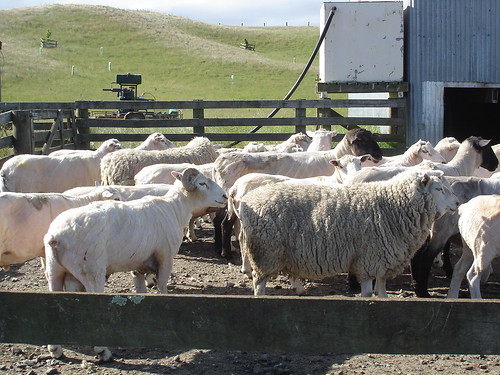
By the time I got there, Greg had already mustered about half the ewes into the paddock by the sheep yards. I got to stand strategically, make Big Scary Noises, and watch Ben and Kaya, the sheepdogs, do their job and get the sheep into the pens:

Watching sheep move like a school of fish really will never get old. (And actually, now that I look at that picture, it looks like Ben's doing all the work; the black spot within the concrete block at the very right of the picture is Kaya having a paddle in the cistern.)

Once we got the ewes in, Greg got to work getting the shearing stations ready and I got to work taking more pictures of sheep.
When the shearers arrived, they started setting up, and Greg and I went back up to the top of the driveway to collect the rams for shearing as well. Greg gave me a four-wheeler and the task of getting the rams back to the sheepyards, which I was more than happy to do. I missed tearing around on four-wheelers!
Look at 'em go! Except, as evidenced by the fact that I could take pictures and drive a four-wheeler at the same time, here's a shot of the spedometer:
Four kilometers an hour. Yeeee haw.
An eternity later, when I finally got the rams out to the sheepyards, the shearers were all set up and ready to go. There were four men and three women, most of them related, and it was amazing to watch them work. They had obviously been working together for a very long time, and seemed almost like a single machine rather than seven different people.
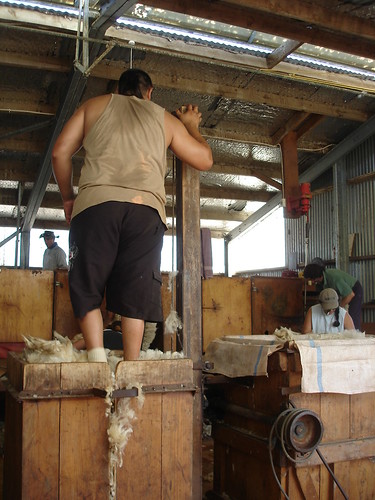
Three of the men were up on the platform, doing the actual shearing, and the three women stood on the floor below, skirting the fleece as it came off, sorting the belly wool, neck wool, and dags into three different piles before taking the remaining fleece to the wool baler, that contraption in the center of the photo there. The sheep on this farm are Romney, Finn, Texel, and Perendale, all varieties that have been bred for meat rather than wool (even though I think the wool is really lovely!). So, rather than selling each fleece individually, the wool gets packed into bales and sent to an auction or an agent who will buy it for carpet wool.
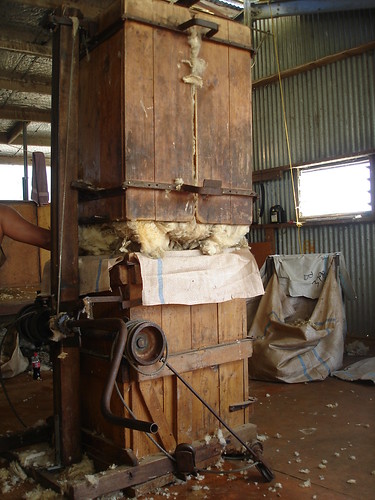
So when each shearer finished with a sheep, the woman on the floor would roll it up and heave it at the wool baler, aiming for either of those two wooden bins. The fourth guy there was in charge of the baler, and would take the fleeces the women threw him and pack them in those bins as tightly as possible. He started with his arms (I got to help with this bit, and my skin up to the elbows was buttery-soft from all the lanolin), but as the bins got more and more full, he just hopped in and stomped on it like he was making wine.
DSC05348Align Center
At first, I thought he had made a mistake--there was only a sack in the right-hand bin, and how was he going to get a sack on the left bin? Surely he couldn't pack them in any tighter. Wrong!
DSC05351
Once he had packed in the bins as tightly as possible (probably about 40-50 fleeces in each bin), he put a square of wood and a very heavy metal lid on top of the left bin, then winched the left bin up until it could easily swing over the right bin. Once they were stacked on top of each other, he secured a rather elaborate pulley system to the metal lid, and with a big lever on the backside of the assembly, slowly compacted aaaaall the already-well-packed wool from the left bin into the just-as-already-well-packed bin on the right. I half-feared and half-anticipated what would happen if the pulleys malfunctioned: a wool volcano! Sadly, they never did.
DSC05355
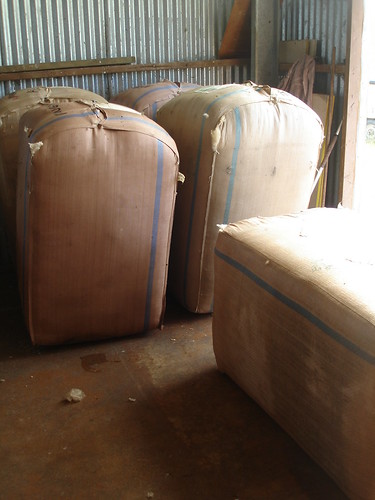
Each bale of wool weighed about 150-200 kilos, and by the end of the day there were about seven of these bales, representing about 250 ewes and about 18 rams. And this was just day one!

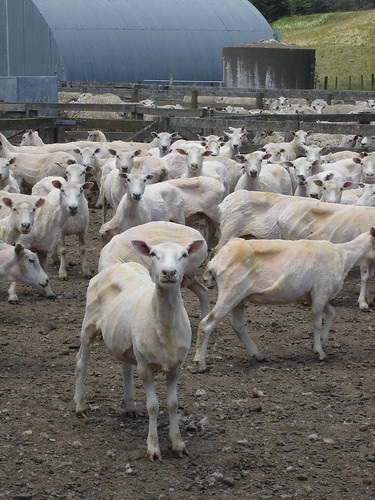
The sheep themselves, although sometimes nicked and slightly dazed, seemed little the worse for wear. However, their heads now seemed waaaay too big for their bodies:
DSC05340
The rams, meanwhile, just looked like football players with very short haircuts:
DSC05358
(Not sure what's going on with the shaggy guy in the front there--he may just have been too ornery to sit still for the shearing.)
Ben the sheepdog and I herded the shorn ewes out into one of the far paddocks for the night (or rather, herded them twice, as I got them all in the right spot before realizing that I hadn't opened the gate. Awesome.), and, after stealing a judiciously large handful of wool, I made my dirty, sweaty, and sheep-greasy way back to Bob and Sandy's. All in all, I couldn't have asked for a better shearing day!

Next up: big city living after two months of complete rural immersion. Do I still remember what traffic lights look like?